

Image and Detail Credit - BBC
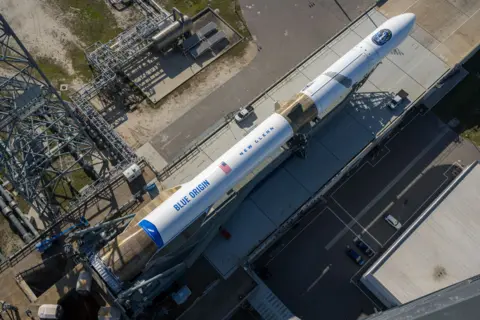
Amazon founder Jeff Bezos's space company, Blue Origin, has successfully launched its first rocket into orbit, marking a bold move to rival Elon Musk's SpaceX in the competitive commercial space race. The New Glenn rocket lifted off from Cape Canaveral Space Force Station in Florida at 2:02 AM local time (7:02 AM GMT), signaling a significant milestone for Blue Origin.
This event intensifies the rivalry between two of the world's richest individuals, each striving to dominate the space industry. Both Bezos and Musk aim to populate Earth's orbit with satellites, establish private space stations, and facilitate regular moon-bound journeys for civilians. Musk, ever the competitor, congratulated Bezos on X, formerly known as Twitter, saying, "Congratulations on reaching orbit on the first attempt!"
Blue Origin's CEO, Dave Limp, expressed pride in the accomplishment, stating, "We’ll learn a lot from today and try again at our next launch this spring." The launch faced delays earlier in the week due to ice formation but overcame these technical hurdles to deliver a spectacular liftoff. Crowds near Cape Canaveral cheered as the 98-meter-tall rocket soared into orbit, marking a significant step forward for Bezos's company.
However, not everything went according to plan. The company’s attempt to recover the rocket’s main booster, designed to land on a platform in the Atlantic Ocean for reuse, was unsuccessful. About 20 minutes into the flight, it was confirmed that the engine was lost, a setback for Blue Origin’s vision of reusability.
Despite these challenges, the New Glenn launch represents a considerable achievement for Blue Origin, which has often struggled to match the rapid pace and accomplishments of SpaceX. The rocket, named after John Glenn - the first American astronaut to orbit Earth—boasts greater power than SpaceX’s Falcon 9 and can carry more satellites. Bezos plans to use New Glenn for his ambitious Project Kuiper, a satellite initiative aimed at delivering broadband services worldwide. This directly challenges Musk’s Starlink, which already has a significant foothold in the satellite broadband market.
Founded 25 years ago, Blue Origin has had a relatively slower trajectory compared to SpaceX. Its smaller, reusable New Shepard rocket has been used for suborbital flights, carrying passengers—including Bezos himself in 2021—and various payloads. Meanwhile, SpaceX has maintained a commanding lead, launching rockets 134 times last year alone. Its next-generation Starship rocket, touted as even more powerful than New Glenn, is set for its seventh test flight later today.
Experts believe New Glenn's success could foster genuine competition between SpaceX and Blue Origin, potentially driving down costs for space operations and accelerating innovation. Dr. Simeon Barber from the Open University in the UK noted, "These two companies will challenge each other to make even greater strides."

Historically, space exploration has relied on billions of dollars in government funding. However, NASA and other agencies are increasingly turning to private companies like SpaceX and Blue Origin to handle rocket launches and other critical services. SpaceX, in particular, has secured lucrative government contracts, and its ties with former U.S. President Donald Trump could further bolster its position.
As the space race heats up, the rivalry between Bezos and Musk promises to push the boundaries of what’s possible, paving the way for a new era of space exploration driven by private enterprise.


0 Comments